

Seadragons
Many people are unaware that seahorses and seadragons are in fact fish. They have evolved some interesting adaptations to life in the sea. The combination of a horse-like snout (for sneaking up on small crustaceans), bony plates (to protect them against predators), and in the case of seahorses, a prehensile tail that allows them to cling to seagrasses, corals, and other holdfasts in ocean currents, has enabled these slow-swimming animals to survive for millions of years.
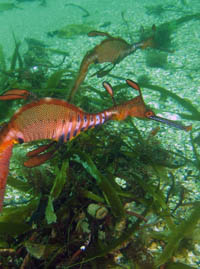
The seadragons consist of only three recognized species, the Common seadragon (Phyllopteryx taeniolatus), the Leafy seadragon (Phycodurus eques) and the newly described Ruby seadragon (Phyllopteryx dewysea). They are more mobile than seahorses and tend to orient at a more horizontal angle than their cousins. Learn more about seadragons here.
Check out the profiles of the species we currently recognize below (Lourie et al, 2016).



IUCN Red List categories
Click here for a full explanation of IUCN Red List categories. A brief key is provided below.

|

|

|

|

|
|

|

|

|
| Extinct | Extinct in the Wild |
Critically Endangered |
Endangered | Vulnerable | Near Threatened |
Least Concern |
Data Deficient |
Not Evaluated |
A note on ‘Data Deficient’ species: Species that are assessed as Data Deficient are deemed to have insufficient information known about them to carry out a proper conservation assessment. Although such species are not assessed as threatened, we may find out that they in fact are, once enough data is obtained.
Banner image of Leafy seadragon (Phycodurus eques) © Gaetano Gargiulo / Guylian Seahorses of the World
[Page updated 11 Aug 2025]